Wine-fabric Wednesday

22 Apr My jewelry roll made with Vino fabric - wine not!

Fellow Quilters,

Welcome to Day 15 of the Time to Quilt quilt-along.  Can you believe we’ll have made 30 blocks by the time we’re done today?!?

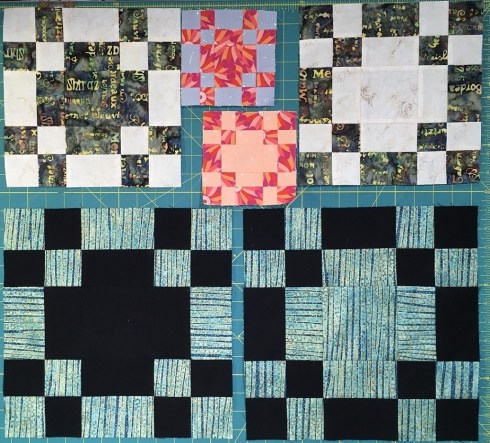
The stack of completed blocks is growing

The stack of completed blocks is growing

And that’s 90 blocks for me, since I’m making 3 different size versions.  I know – you’re thinking “There’s a name for you and it’s not complimentary”.  I have learned a lot in these past 15 days.  Have you?  One thing I hope you’ve learned is that you don’t have to make a block as instructed.  Let’s say you want to make these blocks following the original instructions on the Northcott or Banyan or FIGO Facebook pages instead of my modified version.  That’s okay, you won’t hurt my feelings.  I have developed thick skin – I have grown sons.  If you can think of another or a better or preferred way to make a block, go for it!  Spoiler alert – there are no quilt police.  This is supposed to be fun and we’re supposed to be enjoying this.  If we’re not, it might be time for another hobby.  Speaking of fun…  (haha – another segue!)

I had fun redesigning Block 15.  As I’ve mentioned earlier, all 24 blocks are based on a 9-patch or 3×3 grid.  Well, I looked at Block 15 and saw something else.  I saw a framed square, framed again.  I saw sewing strips onto that center square.

I saw a framed square instead of a 9-patch and eliminated 12 seams

I saw a framed square instead of a 9-patch and eliminated 12 seams

By making the block with a series of strip frames I eliminated lots of seams – 12 to be specific!  I did a quick calculation (full disclosure – I love math 😊) and determined that I saved 12 square inches of fabric by piecing the block using strips.  That’s a 3” x 4” piece of fabric per 9” block.  And lots of cross-seams that I didn’t have to match.  As a result this block was super-fast and easy.

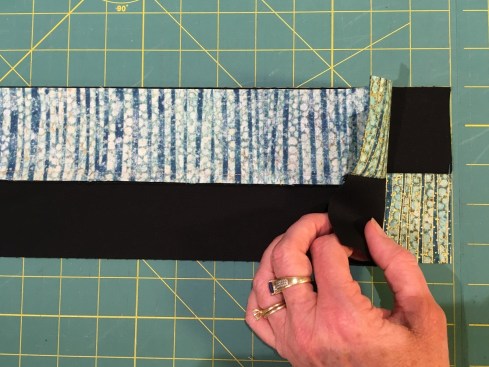
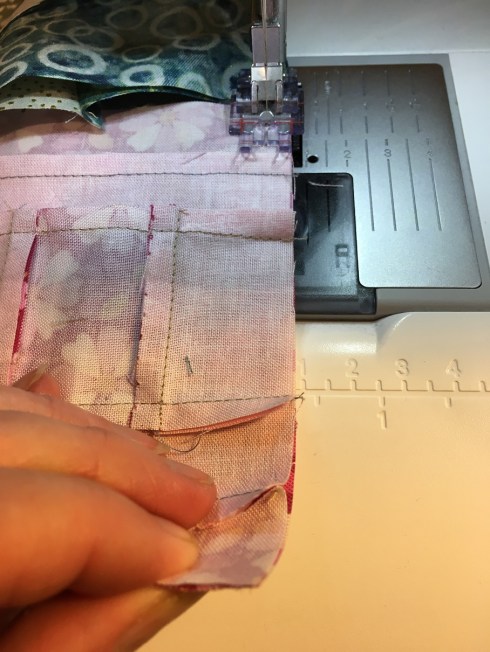
Today’s tip:  When I am sewing a strip to a pieced section I sew with the strip on the bottom and the pieced section on top.

I sew with the seamed piece on top

I sew with the seamed piece on top

Why?!?  So that I can see my seams and I can make sure they go in the direction in which they are finger-pressed.
I can control which direction those seams go

I can control which direction those seams go

This reduces the number of seams that get errantly stitched down in the wrong direction and makes for a smoother flatter quilt.

Quick as a flash these blocks are done!

Block 15 added to the Done pile

Block 15 added to the Done pile

You can find my instructions for Block 15 here.

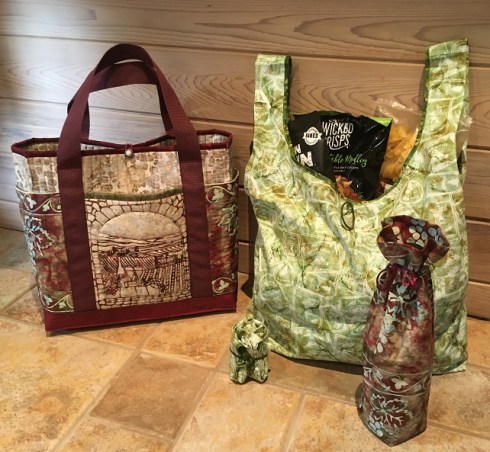
Northcott has used Cosmo for today’s block – the graphic details in this collection are ideal for this block.  Banyan is showing the juicy tempranillo colorway of my Vino collection, including my favorite fabric from the entire collection – the wine names 😊.  I LOVE that fabric!  It’s perfect for wine gift bags and roll-up totes for wine lovers, like in my Tote Bag Trio pattern.
My Tote Bag Trio pattern make these 3 bags

My Tote Bag Trio pattern make these 3 bags

I even used it for a jewelry roll because I love the color.

My jewelry roll made with Vino fabric - wine not!

My jewelry roll made with Vino fabric – wine not!

As for a wine-themed jewelry roll, wine-not? (why not) – it makes me smile when I use it.

Inside view

Inside view

Please also pop on over to Daphne’s blog to see her version of Block 15 and what she’s done with it.

Have a great day!

Patti
So Many Snowballs

21 Apr Soooo many tiny pieces in the make-it-mini version

Fellow Quilters,

It snowed again last night!  I’m glad I still have the snow tires on my car.  Hubby and I live in a snowbelt and our auto insurance requires us to keep our snow tires on until April 15th.  Almost every driver in our area has snow tires for the winter months.  How many of you put snow tires on your vehicle each winter?  How many of you do not get any snow in the winter?  So, all this talk of snow leads us to our block today (what a great segue!).

Block 14 has snowball corners!  There are no changes to the original cutting instructions found on the Northcott and Banyan Facebook pages, however I have some great tips for sewing the units and assembling the blocks.

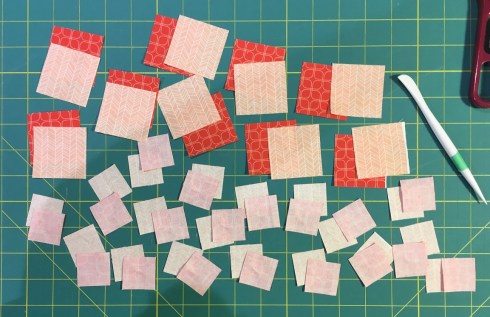
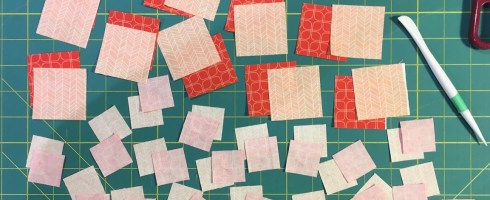
This block takes more fabric than most because of those sew-and-flip snowball corners.  Here are the pieces that I cut for the make-it-mini version – they are really small!  I was not looking forward to sewing those corners.

Soooo many tiny pieces in the make-it-mini version

Soooo many tiny pieces in the make-it-mini version

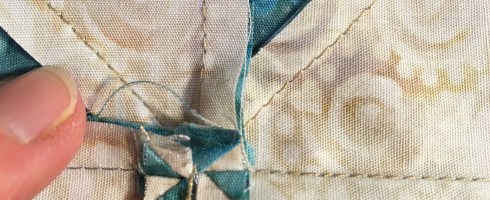
Today’s tip:  When we sew these corners, I find I get the best results if I sew 1 thread thickness to the RIGHT of my diagonal line instead of on the line.

Sew 1 thread thickness to the RIGHT of the diagonal line

Sew 1 thread thickness to the RIGHT of the diagonal line

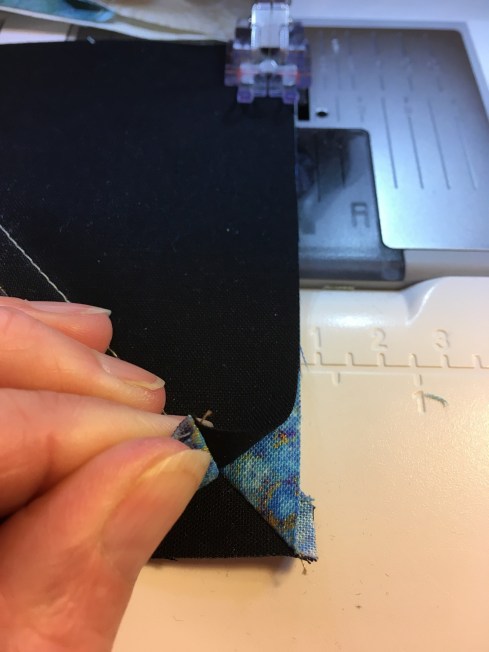
This gives my corner fabric room to flip and still make it to the corner.  I like to check that my triangle lines up perfectly with the original large square, then I trim the excess and finger-press it.

Check that the corner triangle lines up with the base triangle before trimming

Check that the corner triangle lines up with the base triangle before trimming

I was going to share this tip later in the series however I thought you might appreciate having it now since there are 18 snowball corners in each block today (since I’m doing 3 versions, that means I had 108 snowball corners to sew).

Tip #2:  I pressed both seams in each block toward ONE corner – this means that one of the snowball seams is pressed toward the center of the block.  Why?!?  Because when we assemble the units into rows, those seams will lock into each other and have a much better chance of matching.

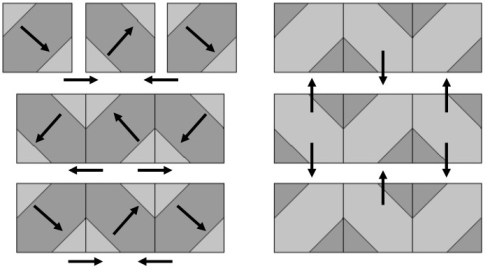
Press the seams in each unit toward ONE corner so they nest together, and press seams following arrows when sewing rows

Press the seams in each unit toward ONE corner so they nest together, and press seams following arrows when sewing into rows

Tip #3:  Follow the pressing arrows when you press the seams in each row.  Originally I was going to press the seams in Rows 1 & 3 in one direction and the seams in Row 2 in the opposite direction but I changed my plan after I pieced the first block.  If we press Rows 1 & 3 toward the center and Row 2 toward the ends, we can spin the seams at the intersections of the block units.  See?

My mini block is perfectly flat because those 4 seam intersections spin

My mini block is perfectly flat because those 4 seam intersections spin

It makes the block lie perfectly flat!  You will be so pleased with the result.  Even my mini block is flat.  And just like that the blocks are done!

Block 14 is done :)

Block 14 is done 🙂

You can find my instructions for Block 14 here.

Northcott is using the ethereal Swept Away collection for today’s block (I used this collection in my Panel Pizzazz pattern), and Banyan has used Patio by Pat Fryer of Villa Rosa – love the colors!  Did you pop on over to Daphne’s blog yesterday?  She had some great layout ideas for Block 13.  I wonder what she’s done for today – check it out here.

Thanks sew much for playing along and I’ll see you tomorrow😊

Patti

Monday Musings

20 Apr

Fellow Quilters,

Good Monday morning!  I am enjoying a bit of raspberry sour cream coffee cake this morning with my tea as I write this post.IMG_2688  I had some sour cream languishing in the fridge, so what better way to use it than a coffee cake, sprinkled with languishing raspberries?  Quite a few of my Facebook friends are trying their hand at baking during this Stay-at-home period.  It’s fun to see their pics of freshly baked bread.  It’s a good thing the aroma isn’t attached to the pictures!
We are whipping through the Time to Quilt quilt-along – on Block 13 already.  I hope you’ve had time to work on the blocks, maybe spent some time over the weekend catching up.  Is anyone else working on the Make-it-mini size?  Please leave a comment on today’s post to let me know if you are.  Yesterday’s block was easy peasy.  Today’s is a bit more involved.  Are you ready for a bit of a challenge?  Then let’s get to it 😊.

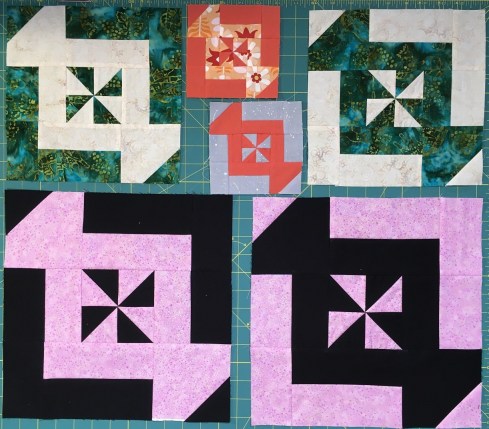
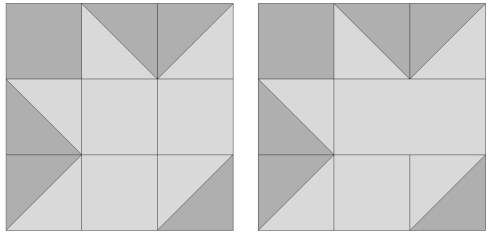
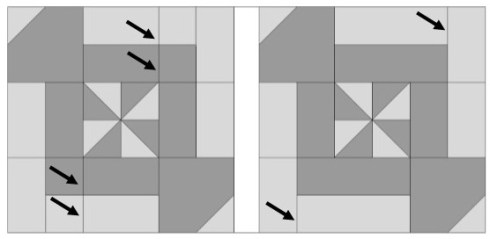
I changed Block 13 around a bit to eliminate a couple seams.

Original Block 13 and my version eliminating some seams

Original Block 13 and my version eliminating some seams

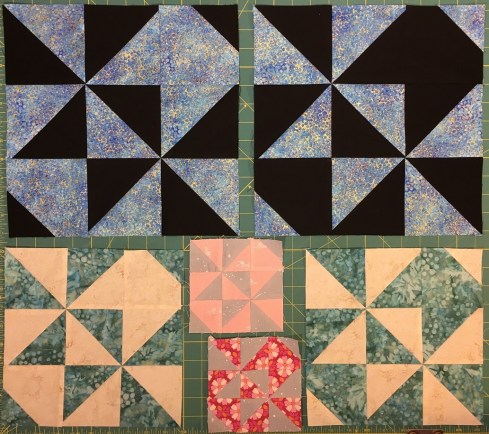
I lengthened the strip-pieced units in the top and bottom rows and simply added a small strip to the end to complete the look of the outer fabric strip rounding the corner of the block.  Let’s talk about how we construct this block.  First we make that center pinwheel.  Are you becoming an expert at half-square triangle units?  Me too!  We spin the seams in the same direction as the half-square triangle seams – notice that the seams in the positive pinwheel spin in the opposite direction to the seams in the negative pinwheel.

Press the seams in the same direction as the half-square triangle seams

Press the seams in the same direction as the half-square triangle seams

The make-it-mini version is REALLY tiny – it’s mostly seam allowance!

You can see a mini pinwheel in the center where the seams spin

You can see a mini pinwheel in the center where the seams spin

Once we have the corner sew-and-flip units and strip-pieced units sewn, it’s time to assemble the block.

Today’s tip:  You may think you can’t chain-piece the units in a 3 x 3 grid like we discussed in Block 6 but you can – sort of.  I chain-pieced the first 2 units in Row 1, then the first 2 units in Row 2, then the first 2 units in Row 3.  It looked like this – note that the left edge of the whole thing is not aligned.  That’s okay.

The units are not aligned at the left edge after chain-piecing the first 2 columns

The units are not aligned at the left edge after chain-piecing the first 2 columns

Then I chain-pieced the third unit in each row onto the 2nd unit.  The block doesn’t want to lay flat – until I clipped the chains in the top right and bottom left.  I leave the top left and bottom right chains – this keeps everything connected so that the components are still all in the right positions.

Leave these 2 chains connected to keep the block components together

Leave these 2 chains connected to keep the block components together

Then I simply sewed the 3 rows together.  Done!

Block 13 done! Perfect pinwheels

Block 13 done! Perfect pinwheels

You can find my instructions for Block 13 here.

Northcott has used the Spring-like Chelsea collection in their block and quilt today, and Banyan is using Rough Sketch for theirs.  Pop on over to FIGO’s Instagram to see what Christina uses for today’s block, and Daphne has some great ideas on her blog.

Let me know how you’re doing.  Is the pace too fast or just right?  Are you making one of the alternate sizes (the make-it-mini or super-size)?  Leave a comment below – thanks😊

See you tomorrow,

Patti


Sunday’s Strip-piecing tip

19 Apr I stack my strip sets, offsetting them by an inch or so to cut multiple pieces at once - faster!

Fellow Quilters,

Today’s post will be quicker than most – I have another important job on my To Do list today.  I’m tasked with cutting Hubby’s hair.  I used to cut his hair when he was working and wore it quite short.  Now it’s a bit longer and he’s been using a local barber recently.  If all else fails, he has lots of different hats.  And hair grows – my bad styling effort is temporary.  At least we already have a hair trimmer – I hear they’re a hot commodity at Walmart these days.

So we are at the half-way mark of the Time to Quilt quilt-along – woo-hoo!

Block 12

Block 12

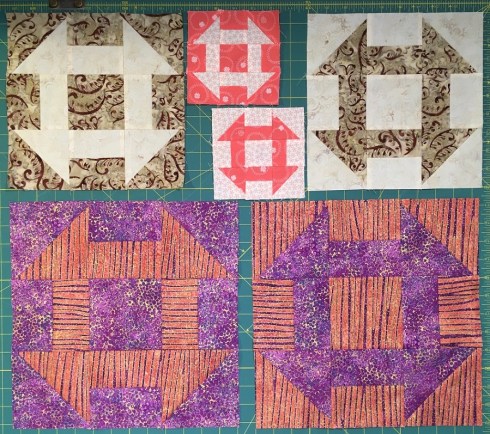
Time to Quilt Block 12 looks very familiar to me – I think it may also be known as monkey wrench, hole-in-the-barn-door and churn dash.  I found the picture below of a fun quilt using 3 sizes of this block – you could make something like this with my instructions since I include 3 sizes!

Barn Dance QAL from Justquiltin.wordpress.com's site

Barn Dance QAL from Justquiltin.wordpress.com’s site

Yet again my cutting instructions don’t vary from the ones on Northcott’s, Banyan’s and FIGO’s Facebook pages – I haven’t rejigged the block at all.  We’re making the half-square triangle units like we have for several of the previous blocks.  And we’re strip-piecing the skinny strips like we did in Block 10.  My tip relates to those strip-pieced segments.

Today’s tip:  When I have a few units to cut from strip-pieced segments, I stack the segments on my cutting mat so that I can cut lots at once instead of cutting them individually.  I lay the first strip set on a horizontal line on my mat.  Then I lay the next one on top, aligning it with a different horizontal line on the mat, checking that the seam allowances aren’t stacked on top of each other.

I stack my strip sets, offsetting them by an inch or so to cut multiple pieces at once - faster!

I stack my strip sets, offsetting them by an inch or so to cut multiple pieces at once – faster!

I can stack several strip sets, off-setting each one by an inch or so.  It makes quick work of getting those units cut.  This concept works well for rail fence blocks, and I even use it when I am cutting out diagonal segments for lone star quilts.

Next thing you know, today’s blocks are done!

Block 12 done

Block 12 done

You can find my instructions for Block 12 here.

Oh, by the way, I found 2 typos in yesterday’s pattern for Time to Quilt Block 11 ☹.  Sorry about that! I corrected the version on my blog shortly after I posted (the quantity of half-square triangle units should be 14, and the squares in step 3 were incorrectly labelled).

Northcott has used Material Girl in their block and quilt today (this collection speaks to me!), and Banyan is showcasing the elegant teal colorway of Vintage Chic. And I’m sure Daphne has some cool ideas on her blog today (we post around the same time so some days I post just before her and don’t see what she has done).  If you posted pics of your blocks on Friday on FIGO’s Instagram feed, pop over there to see if you’re a winner.

Have a great day and I’ll see you tomorrow 😊

Patti


Saturday Smoosh

18 Apr Pull the pinwheel apart. The vertical stitches in the seam allowance will come undone - this is okay!

Fellow Quilters,

Welcome to Day 11 of the Time to Quilt quilt-along.  I’ve seen some great photos of daily blocks and design walls being filled in with the completed blocks to date.  Keep them coming!  They tell me that you’re following along.  If you posted blocks yesterday on Northcott’s Facebook page, pop on over to see if you’re a winner.

Just in case you think I’ve got these daily patterns, blog posts and quilting tips prepared ahead of time let me assure you that I don’t – in fact I am only 2-3 hours ahead of you getting my block done!  And every day as I sit down to sew my block, phone at the ready to snap some pics for the blog post, I am thinking “Okay, what will I be able to come up with today for a tip? What if I can’t think of one?!?”  Fingers crossed that won’t happen.  Have you learned something new from the tips?  Let me know your favorite one so far!

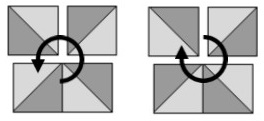
So, on to Block 11.   I didn’t change the cutting and instructions for this block at all – there was no easier way that I could think of to cut and piece it.  We’ve made the half-square triangle units and sew-and-flip corner triangle units in several of the earlier blocks.  One thing I did notice when I was assembling the block is that a few of those half-square triangle units will nest together when we sew one unit to the adjacent unit.

The angled seams in the half-square triangle units nest for perfect points

The angled seams in the half-square triangle units nest for perfect points

This helps our triangle seams form perfect points.  My cool hack for this block comes once it is done.

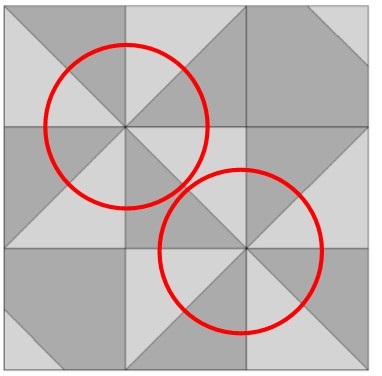
Today’s tip:  Tip #3 in yesterday’s post showed us how to spin those seams in the 4-patch unit to distribute the bulk of those 4 seams coming together.  Well, we’re going to apply the same concept to today’s block and take it to the next level.  When you look at the block can you see 2 pinwheel intersections, where 4 half-square triangle units come together?

2 pinwheel intersections

2 pinwheel intersections

We’re going to cut the thread chain (if we have chain-pieced our block units together).

Cut the thread chain linking the 2 rows

Cut the thread chain linking the 2 rows

Then we can make the seams spin in the same direction as the vertical and horizontal seams at the intersection.

Pull the pinwheel apart. The vertical stitches in the seam allowance will come undone - this is okay!

Pull the pinwheel apart. The vertical stitches in the seam allowance will come undone – this is okay!

I learned this tip in a pinwheel workshop with quilting icon Eleanor Burns many years ago (yes, we also learned to throw our scraps over our shoulder 😊).  To really flatten that seam intersection, we “smoosh” it with our thumb on the back of the block – press and rotate in the same direction as the seams.

What this means is that 2/3 of each horizontal row is pressed in one direction and 1/3 of the row is pressed in the other direction.

2/3 of each horizontal row is pressed in one direction and 1/3 is pressed in the other direction

2/3 of each horizontal row is pressed in one direction and 1/3 is pressed in the other direction

And there you have it – the blocks are done!

Block 11 done :)

Block 11 done 🙂

You can find my instructions for Block 11 here.

Northcott has used the dreamy Tree of Wisdom for their block and Banyan has used Sazerac by Tiffany Hayes of Needle in a Hayes Stack (do you know what a Sazerac is?).  Christina will be posting FIGO’s block shortly, and pop on over to Daphne’s blog to see what she has done with Block 11 made with Tapa Cloth.

Have a great day 😊

Cheers,

Patti

Four-patch Friday on Day 10 of Time to Quilt

17 Apr My original quilt with no black in the blocks and my revised version with some black - it's still a work-in-progress

Fellow Quilters,Time to Quilt logo

Welcome to Day 10 of the Time to Quilt quilt-along!  Last night I finally found some time to tweak my quilt design for the super-size Shimmer option.  Shimmer is one of my all-time favorite Northcott collections so I was excited to use it for the quilt-along however, when I colored the quilt based on the template posted on the Northcott Facebook page a few days ago, the quilt didn’t look the way I expected.  Does that ever happen to you?  You make all the blocks for a quilt using that perfect selection of fabrics, then sew them into the quilt and…hmmm…ho-hum…another UFO.  As I mentioned on Day 1, my pieces of Shimmer might be a bit small to get all the required pieces for the blocks, so I was considering adding some solid black from Northcott’s ColorWorks.  I’m not changing any of the blocks that are already completed so I randomly recolored a few of the upcoming blocks.  Here is my original quilt design and the revised one with some black thrown into the mix.

My original quilt with no black in the blocks and my revised version with some black - it's still a work-in-progress

My original quilt with no black in the blocks and my revised version with some black – it’s still a work-in-progress

Now, the blocks are not in their final placement – it would take waaaay too long to move them around in EQ – but I feel pretty confident that I’ve got a good mix now.  The addition of black background to some of them adds interest to the quilt.  So, what does this mean for your quilt?  If you are using sashing, you may want to replace one of the fabrics on some of the remaining blocks with some of your sashing fabric – or not!  The choice is yours.  We all have our own comfort level with how busy we want our quilts to look.  My Midsommar make-it-mini will look busier because there is no sashing to tone it down – I’m okay with that.  Some modern quilts ARE busy.

Block 10

Block 10

For Block 10 I decided not to make any changes in the original pattern posted on Northcott’s, Banyan’s and FIGO’s Facebook/Instagram pages/feeds.  That’s 3 days in a row with no changes!  I could have eliminated 2 small seams however I weighed my options and decided that it was probably faster to make the block as originally patterned.  You see, everything but the center square is made from strip-pieced units, and strip-piecing is fast – sew a light strip to a dark strip, cross-cut into the required sizes and assemble the units.

Cross-cut the strip set to make 4-patch units

Cross-cut the strip set to make 4-patch units

Today’s tip:  The corners of each block are made from units with 2 lights and 2 darks –  we call them 4-patch units.  We cut these from our strip-pieced units and sew 2 pieces together, stacking the light part of one piece on the dark part of the other piece.  To make this faster, let’s stack our strip sets this way to cut these pieces.

Stack 2 strip sets light-on-dark and dark-on-light to cut the pieces for the 4-patch units

Stack 2 strip sets light-on-dark and dark-on-light to cut the pieces for the 4-patch units

Then when we pick them up off our cutting mat they are perfectly aligned and ready to be sewn together.

Tip #2:  Our seams will match better in these 4-patch units if we sew them with the seam of the top piece going away from us and the seam on the bottom piece coming toward us.

Sew with the top seam going AWAY from you and the bottom seam TOWARD you

Sew with the top seam going AWAY from you and the bottom seam TOWARD you

Tip #3:  After sewing the 4-patch units, finger-press the seams all in one direction – clock-wise or counter-clock-wise, depending on the direction of the strip-pieced seams – and let the stitches in the seam allowance at the center become loose so you can spin the seams and press them flat.  This distributes the bulk from that center seam.

I pushed the seams in a counter-clockwise direction and let the stitches in the center pop undone to flatten the intersection

I pushed the seams in a counter-clockwise direction and let the stitches in the center pop undone to flatten the intersection

Once the 4-patch units are done, we assemble our blocks and we’re done.

Block 10 done :)

Block 10 done 🙂

You can find my instructions for Block 10 here.

I have a short To Do list for your today:

1)  It’s Friday a.k.a. Prize Day so head on over to the Northcott Facebook page and post pictures of your blocks from this week.  You only have until midnight EST to enter this week’s random draw.  Everyone who posts has a chance to win.

2)  Check out the Facebook pages to see the cool quilts made with today’s block – Northcott has used Shimmer coral and Banyan has used Ocean Park by Scott Hansen of Blue Nickel Studio.  I met Scott and his wife and daughter at Quilt Market a couple years ago – he is so much fun!

3)  See what Daphne has been up to with Block 10 on her blog.

Enjoy your day and I’ll see you tomorrow 😊

Cheers,

Patti

Time to Quilt Block 9 is here

16 Apr The scored line shows up well on busy fabrics

Fellow Quilters,

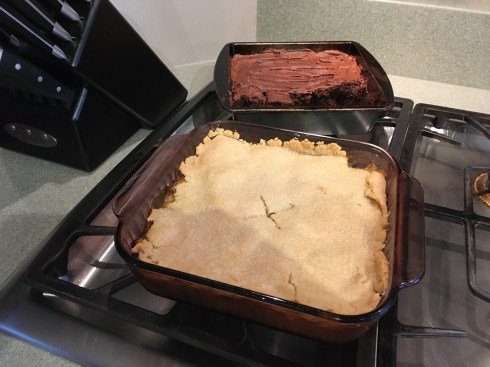
Do you like leftovers?  Hubby and I sometimes like them better than the original meal.  Lasagna, for instance, is so good as leftovers.  Last night I made a turkey pot pie with the leftover turkey from Sunday’s dinner.

Last night's dinner - turkey pot pie and chocolate brownies - yum!

Last night’s dinner – turkey pot pie and chocolate brownies – yum!

I make my own pastry – it’s quite easy.  The next time I make some I’ll show you my tricks and tools to make it almost foolproof.  Here’s an easy hack for the best pastry ever for savoury pies – put 3-4 tbsp of parmesan cheese in the flour before you add the shortening or butter.  It makes the pastry “short” – it crumbles in your mouth – and really tasty.  I made some chocolate brownies too, from a mix (I was too busy sewing blocks!).  It’s almost as good as homemade – at least Hubby says so.  What cooking or baking hacks do you have?  Which mixes are as good as homemade?

Shall we get to today’s block?  Time to Quilt Block 9 is another straightforward block similar to Blocks 1, 6 and 8 in that it has half-square triangle units and squares – that’s it!  And just like yesterday’s block I have no modifications to the original instructions posted on Northcott’s, Banyan’s and FIGO’s Facebook page other than the addition of the make-it-mini and super-size versions.  I do however have a handy marking tip for those half-square triangle squares:

Today’s tip:  My second favorite tool for quiltmaking (my favorite tool is of course my E-Z Miter tool for fast fool-proof mitered borders and lone stars 😊) is the Clover Hera marker for applique.

Clover Hera Marker for applique

Clover Hera Marker for applique

It is smaller than the regular Hera marker I often see when I teach.  I usually use this tool for finger-pressing my seams to one side before I press with an iron.  In fact I tend not to press with an iron until the block is finished – that’s how good a job the Hera marker does at finger-pressing.  You can see a short YouTube video of me using it for this purpose here.  I also use the pointy end as a stiletto when I am feeding the patches under the presser foot as I sew them.  The third use is one the tool was actually intended for, and that is scoring a line on the fabric.  Instead of drawing those diagonal lines on the A squares with a pen, I can use the Hera marker.

I use the Hera marker instead of a pen to score the diagonal line on my A squares.

I use the Hera marker instead of a pen to score the diagonal line on my A squares.

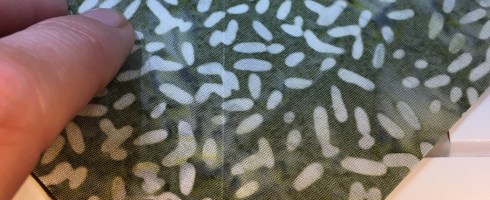
(I should have used the Hera marker instead of a pen when I drew the lines on the wrong squares while making Block 5 ☹.)  It works particularly well on busy fabrics where a line is hard to see.

The scored line shows up well on busy fabrics

The scored line shows up well on busy fabrics

The regular Hera marker works just as well – press just hard enough to see the line, not hard enough to cut the fabric.  Some of the regular ones have a very sharp edge.

I wasn’t paying attention to my Midsommar quilt layout photo and forgot to replace some of my fabric with background gray, so I had some “frogging” to do – RIP-IT, RIP-IT.

Extra pieces cut and sewn in error

Extra pieces cut and sewn in error

Before I knew it the blocks were done!

Block 9 is done!

Block 9 is done!

You can find my instructions for Block 9 here.

Northcott has used a pretty dogwood floral from The Joys of Spring for their block today, while Banyan has used Jungle Rose.  The 2 quilts look so different even though the layout is the same!  Pop on over to Daphne’s blog to see 2 other layout options for quilts made with Block 9 and to see what’s on her design wall.

Have a great day and I’ll see you tomorrow 😊

Patti


15 Apr My growing stacks of blocks

Fellow Quilters,

My pile of completed blocks from the Time to Quilt quilt-along is growing!

My growing stacks of blocks

My growing stacks of blocks

Doing 3 sets per day is keeping me hopping.  Have you been keeping up with me?  I know some of you have, because I’ve seen photos of your blocks.  Have you tried the easy block assembly tip I gave you in the Block 6 pattern and shown in the photos in my blog post for Block 7?  I’m interested in your feedback – it’s so much easier to show something in a live demo than using step-by-step photos or just words.  By the way, this assembly method is applicable for most of the 24 blocks in the quilt-along, so if you’re only on Block 2 or 3 you can still use it.  Trust me – I did!

So, for Block 8 I actually followed the original pattern to the letter.  Yup, no changes, just the addition of the make-it-mini and super-size versions and the block layout diagram.  Once again I had just a couple of scraps of one of the fabrics for the Midsommar version so I purposely chose this block for this fabric, knowing that I could manage to get all the required pieces from my 2 bits of red fabric.

2 small scraps of red for my Midsommar version

2 small scraps of red for my Midsommar version

One of the Shimmer fabrics is a stripe – how fun!  I love using stripes in my quilts – they add an element of interest – however sometimes we might want to select how we use them.  Sometimes I want to manage the direction of the stripe to control how the finished block looks.  Let me explain.

In this block the stripe fabric is used in the B squares and also in the A half-square triangles.  If we draw the diagonal line in the same direction on all the stripe A pieces our quilt blocks will look like this.

The stripe fabric in the half-square triangle units is not in a consistent direction in the blocks

The stripe fabric in the half-square triangle units is not in a consistent direction in the blocks

I would prefer if my blocks look like this.

The stripe fabric in each unit is in a consistent orientation - I like this better.

The stripe fabric in each unit is in a consistent orientation – I like this better.

How can I manage this?

Today’s tip:  Knowing that half of my half-square triangle blocks would slope up to the left and half would slope up to the right, I drew half my lines sloping up to the left and the other half sloping up to the right.

I selected the orientation of my A pieces when drawing the line to make the half-square triangle units

I selected the orientation of my A pieces when drawing the line to make the half-square triangle units

Bingo!  I got the results I was looking for.

Once those half-square triangle units are done, this block goes together lickety-split.  I pressed the seams toward the B pieces and middle row, and we’re done!

Block 8 done :)

Block 8 done 🙂

You can find my instructions for Block 8 here.

Did you see what Christina did with yesterday’s block on the FIGO Facebook post?  Her min quilt is fabulous!  Today Northcott has used scrumptious Shimmer for their block and Banyan’s block features Intaglio – lovely!  And be sure to check out Daphne’s blog post – she talks about how she designed the fabrics used in her block today.

See you tomorrow 😊

Patti


Triangle Tip Tuesday

14 Apr My door-hanger on my longarm machine in my sewing room

Fellow Quilters,

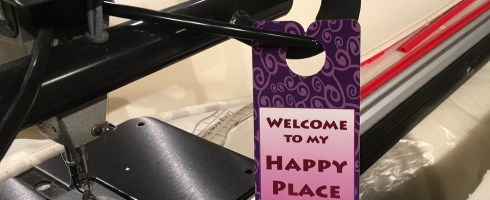
Just when I thought Spring was finally here it snowed last night.  The daffodils that were ready to bloom on Sunday when it was a balmy 13°C (55°F) are now dusted with snow, and the robins are having a harder time finding nest-building supplies now under a layer of white stuff.  It’s interesting to watch them manage in these adverse conditions, just as we are managing these unprecedented times.  Have you found that an hour or two of quilting is your therapy?  I have this door-hanger on the handle of my longarm machine and it makes me smile.

My door-hanger on my longarm machine in my sewing room

My door-hanger on my longarm machine in my sewing room

Quilting is good for us – statistics show that it reduces stress.  So let’s get to our Time to Quilt stress-reduction for today 😊

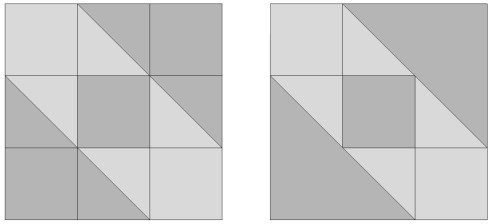
Time to Quilt Block 7 is another block that I couldn’t leave well enough alone.  Now, you can easily download the original pattern on Northcott’s, Banyan’s and FIGO’s Facebook pages like everyone else is doing.  Nothing wrong with that at all!  However, I have another hack to make this block easier and faster, ‘cause that’s what I do – I can’t help it, it’s how my brain is wired.  Work with me for a minute here while I explain…

When I looked at this block, I saw large triangles in the two opposite corners – do you see them too?

original Block 7 vs my revised Block 7

original Block 7 vs my revised Block 7

We can eliminate 4 seams in the block by using a large triangle in place of the corner square and two small triangles.  Let’s do it.

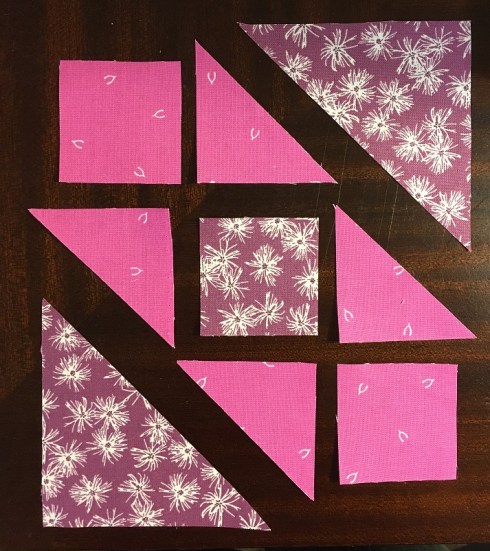
So, yesterday my tip showed you how to assemble the block faster by chain-piecing the units and sections.  We’re going to do the same thing with the center part of this block.  I laid out the components for the block.

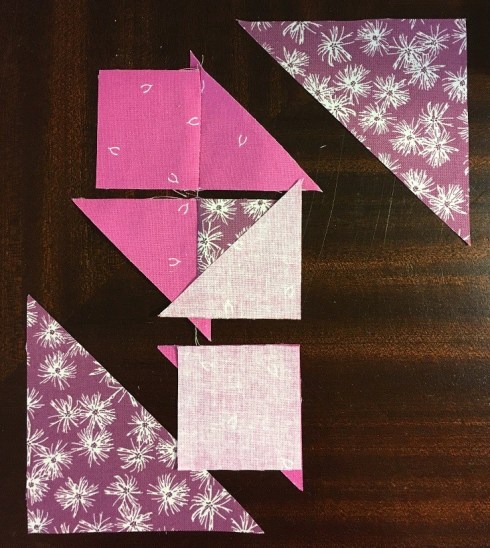
The squares and small triangles form 3 rows of 3

The squares and small triangles form 3 rows of 3

Can you see that the squares and small triangles are arranged in 3 rows and 3 columns? Ignore the 2 large triangles for a moment.  Note that Row 1 is missing a piece in Column 3, and Row 3 is missing a piece in Column 1 – that’s okay.  I flipped the triangle and square in the 2nd column onto the square and triangle in the first column, then chain-pieced them and placed them back into my arrangement.

Flip the pieces in Column 2 onto the pieces in Column 1

Flip the pieces in Column 2 onto the pieces in Column 1

Sew Column 2 to Column 1, finger-press seams toward squares and place back into the layout

Sew Column 2 to Column 1, finger-press seams toward squares and place back into the layout

Then I flipped the triangle and square in the 3rd column onto the square and triangle in the 2nd column and chain-pieced them.

Flip the pieces in Column 3 onto the pieces in Column 2

Flip the pieces in Column 3 onto the pieces in Column 2

The 3 rows are connected by the thread chains and ready to sew together.

The 3 rows are connected by the thread chains and ready to sew together.

I finger-pressed my seams toward the squares as indicated in my instructions.  Then I sewed the 1st row to the 2nd row – they’re still connected by that thread chain – then sewed the 2nd row to the 3rd row and finger-pressed the seams toward Rows 1 & 3.

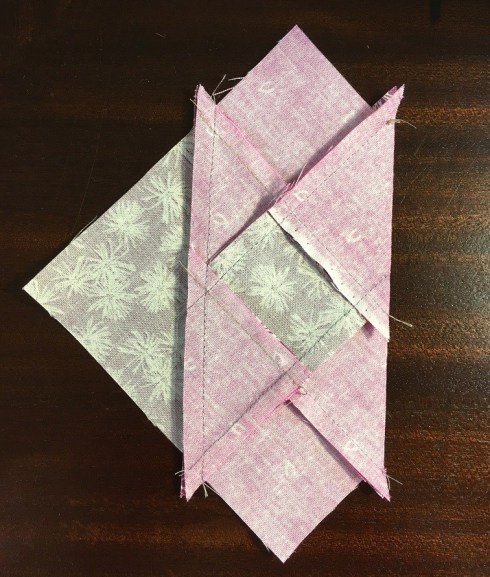
I sewed the 3 rows together and finger-pressed toward Rows 1 & 3. Leave the triangle tips on!

I sewed the 3 rows together and finger-pressed toward Rows 1 & 3. Leave the triangle tips on!

Today’s tip:  I thought about trimming those triangle tips but I stopped – I will used them as a guide when I sew the corner large triangles onto the block.  I laid my center section face down on my large triangle and aligned the triangle tips with the ends of my large triangle, then I sewed the seam.

Lay the center section on the large triangle, aligning the triangle tips

Lay the center section on the large triangle, aligning the triangle tips

Now I trimmed my triangle tips. Perfect!  Done!

Block 7 done :)

Block 7 done 🙂

You can find my instructions for Block 7 here.

Pop on over to my friend Daphne’s blog to see what she’s done with today’s block.  Northcott has used Rod & Reel in their block/quilt and Banyan is showing Cherry Blossoms – pretty!

See you tomorrow 😊

Patti


Make-it-Fit Monday – Day 6 of Time to Quilt

13 Apr A close-up

Fellow Quilters,

Happy Monday!  How many of you had a fancy dinner last night for Easter?  I’ve seen a few posts on Facebook that show a traditional turkey dinner with all the trimmings and only 1 or 2 people are sitting at the table as we continue to practice social distancing.  What did you prepare for dinner, or have delivered by a friend/neighbor? There will be lots of leftovers this week – leftovers are the best!  Turkey pot pie is on the menu for Wednesday at our house, and Hubby is looking forward to turkey sandwiches until then, especially with that Gran Marnier cranberry sauce I made yesterday.

Today is Block 6 of the Northcott/Banyan/FIGO Time to Quilt quilt-along.  Do you have a favorite block so far?  My modern side is leaning toward Block 2 and Block 4.  And I’m getting used to sewing the piddly little pieces in the Midsommar make-it-mini size.  Although I usually don’t work with pieces that small, I must admit that the Midsommar blocks are adorable and I am super-pleased that the seams are matching nicely in the blocks.  So, let’s get to the block.

I made one small tweak to the instructions posted on Northcott, Banyan and FIGO’s Facebook/Instagram pages – I replaced a section of 2 plain squares with a rectangle to eliminate 1 seam.

original Block 6 and my revised version replacing the 2 center squares with a rectangle

original Block 6 and my revised version replacing the 2 center squares with a rectangle

It seems insignificant, but in the make-it-mini version it reduces bulk (there is proportionately a lot more seam allowance in this size).  I also had small scraps of fabric for this version and couldn’t get 5 A squares and 4 C squares from my scraps.

My 2 scrap pieces of Fabric #2 for the Midsommar version

My 2 scrap pieces of Fabric #2 for the Midsommar version

Converting 2 C squares into a B rectangle saved me ½” – it made the difference between being able to use this fabric and not.  I had 1/8” left over at the end of my scrap of fabric after cutting my pieces.  Because we need the same pieces from each of the 2 fabrics used in the blocks I usually stack my 2 fabrics and cut them at the same time – it speeds up the cutting process, reducing the time required by almost half.  I did this for the Vino and super-size Shimmer versions.

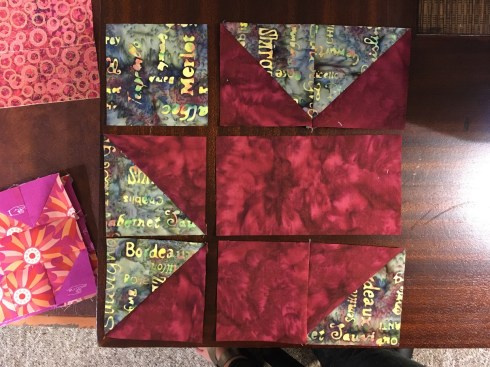
Today’s tip:  Once I have the half-square triangle units sewn, it’s time to assemble the block.  I sew the 2 HST units in the top row together and I pressed the seam open to reduce bulk.  In the bottom row I also sewed the C square and right HST unit together.  Then I arranged the components of the block in 3 rows, with 2 units/pieces in each row as shown.

Block 6 ready for assembly

Block 6 ready for assembly

I flipped the right-hand sections face down on the left-hand units, aligning them along the right edge. Then I chain-pieced the 2 units in row 1, then the 2 units in row 2, then the 2 units in row 3 so that they are all connected by a thread chain.

I flipped the right-and column of sections face down onto the left column of units and chain-pieced them

I flipped the right-hand column of sections face down onto the left column of units and chain-pieced them

Here’s the important part – I didn’t cut them apart.  I kept them linked by the thread chain because this keeps the 3 rows in the correct order and correct alignment (not flipped around or upside down).

The 3 rows connected by a thread chain

The 3 rows connected by a thread chain

A close-up

A close-up

Then I sewed the horizontal rows of my block.  Easy peasy and much faster because I chain-pieced and didn’t have to go back to my notes to verify which row is top, middle, bottom and which unit is on the left edge/right edge.  This speeds up the block assembly by at least 50%. I cannot take credit for this concept.  I learned this from the book “400 Quilt Blocks to Sew in 20 Minutes or Less” by Linda Causee.  Thank you Linda!  And just like that, Block 6 is done!

Block 6 done!

Block 6 done!

You can find my instructions for Block 6 here.

Northcott has used the pretty Bouquet collection for today’s block, and Banyan is showing Baralla – lovely!  And I’m sure Daphne has some great layouts for you today too.

See you tomorrow for Block 7 😊

Cheers,

Patti